On Sunday I took a look at Glasgow, a town I have previously only passed through without stopping. Here’s my commentary: a mix of cameraphone and proper camera photos; some of the commentary comes from the live tweets that accompanied the cameraphone pictures.

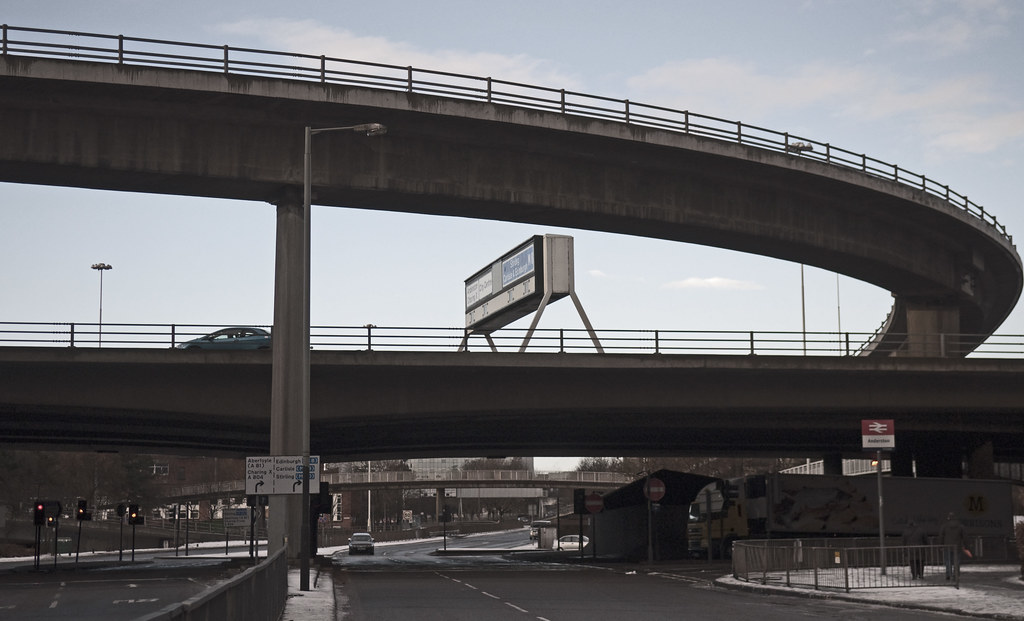 The great overwhelming presence in Glasgow’s built environment is the M8, which crashes through the centre of the city, dividing the central business district from the inner suburbs, and filling them both with a tangle of concrete flyovers and junctions. While several British cities have motorway arterial routes, a massive backlash prevented the planners of the 1960s implementing their dream of flattening our city centres and neighbourhoods to build networks of through motorways. Instead, most cities stuck to bypasses and orbitals, with smaller and not quite so destructive inner-city ring roads. In this through-motorway design with big city centre grade-separated junctions, Glasgow looks very North American.This is how intrusive the motorway is on a sunday evening. I wonder what it’s like on a weekday…
There are odd bits of old concrete next to recent regeneration projects, like this — presumably once a footbridge, closed, perhaps, because it all depressed people so much that they jumped off?
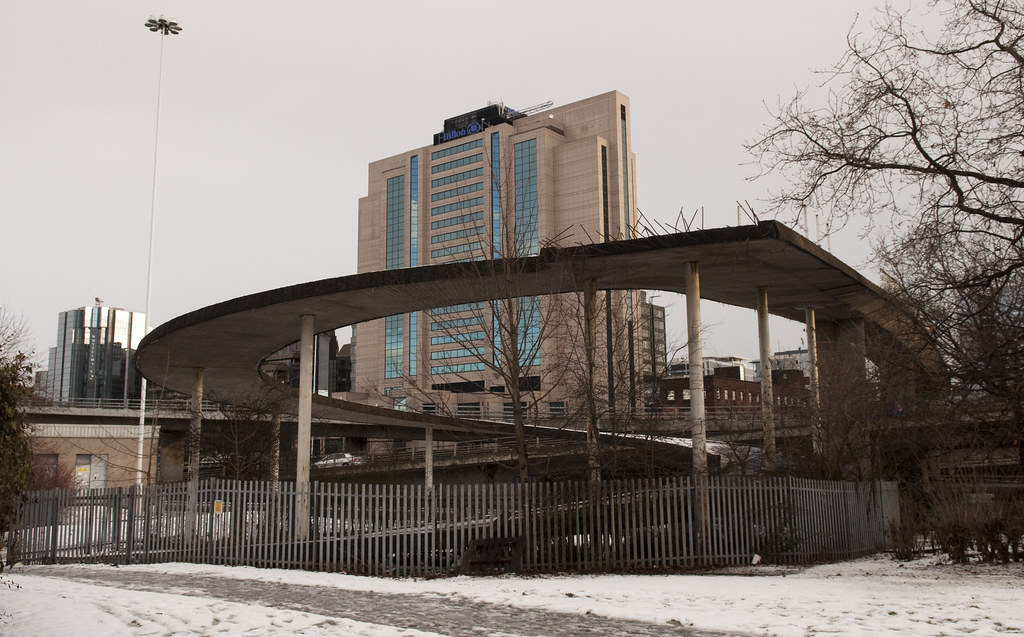
Weird half-demolished monuments, left here in ruins as a warning to future generations?
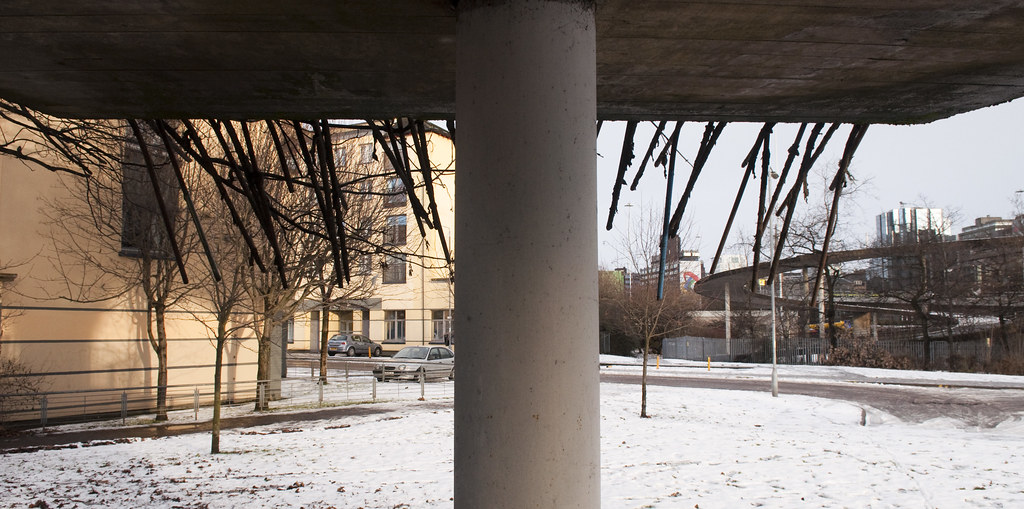
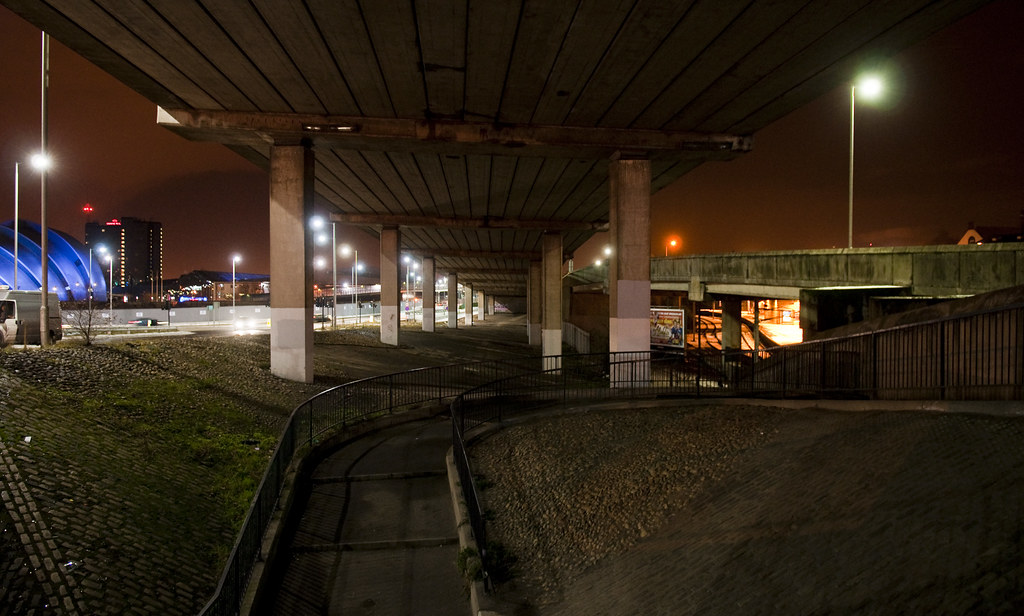
These days you have to go under the road, in the dark labyrinth of slip roads and columns and surreal street furniture. There’s a helpful tourist information sign.

Beyond the M8, there are other roads — motorways in all but name — from a similar era and of a similar design — stained old concrete, crumbling pedestrian underpasses, and bent and battered railings:
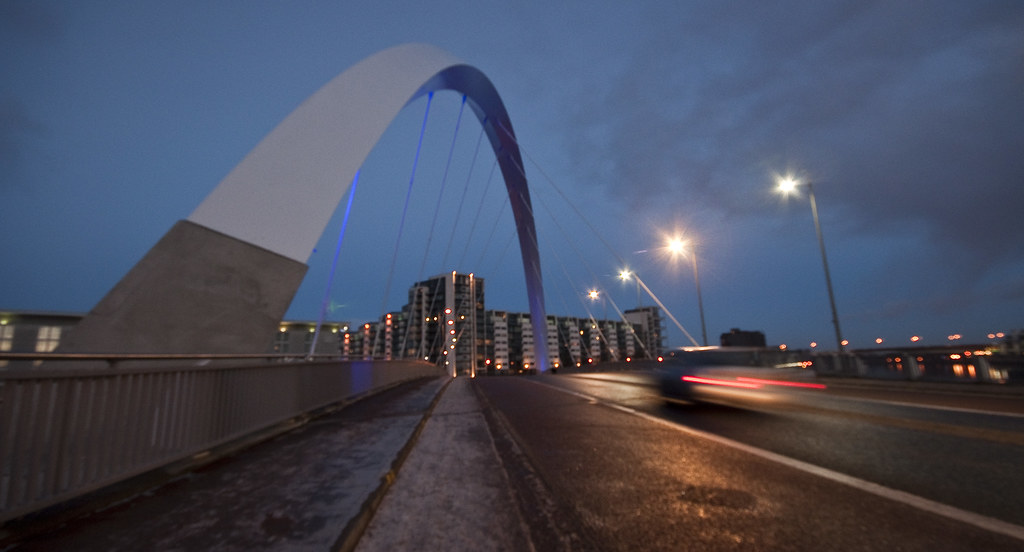 But the most depressing thing about it all is not the destructive roads of the 1960s and 70s, but the fact that the authorities seem to be unable to learn from these mistakes. Despite everything that Glasgow has already seen and been through, and despite everything we know about supply inducing demand and the futility of congestion relief, Glasgow has just in the past year opened a new motorway smashing through the inner city to join the M8, in the hope of relieving its congestion and magically revitalising the city centre. And that’s not the only major new road construction going on.
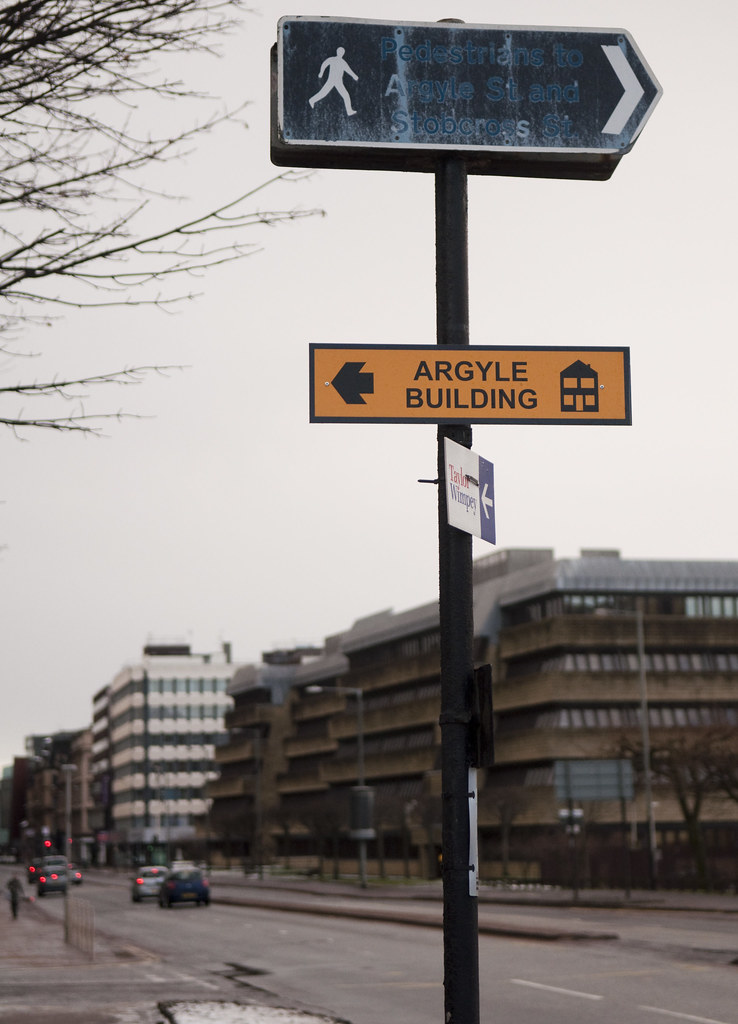
 There are lots of wide streets in the centre, all given over to cars — not even much in the way of bus lanes for these dual carriageways and grid-pattered one-way streets (another feature reminiscent of the US). From the image on this walking directions sign, it looks like you’re expected to run across the road, for there is no crossing here, only drop kerbs. Depressing though these streets are, you could think of them in terms of “things can only get better”. Not even a moron of Boris Johnson proportions could look at Glasgow and claim that there is no room for proper joined-up dedicated cycling infrastructure on these streets. If there were the political will, the implementation would be simple.
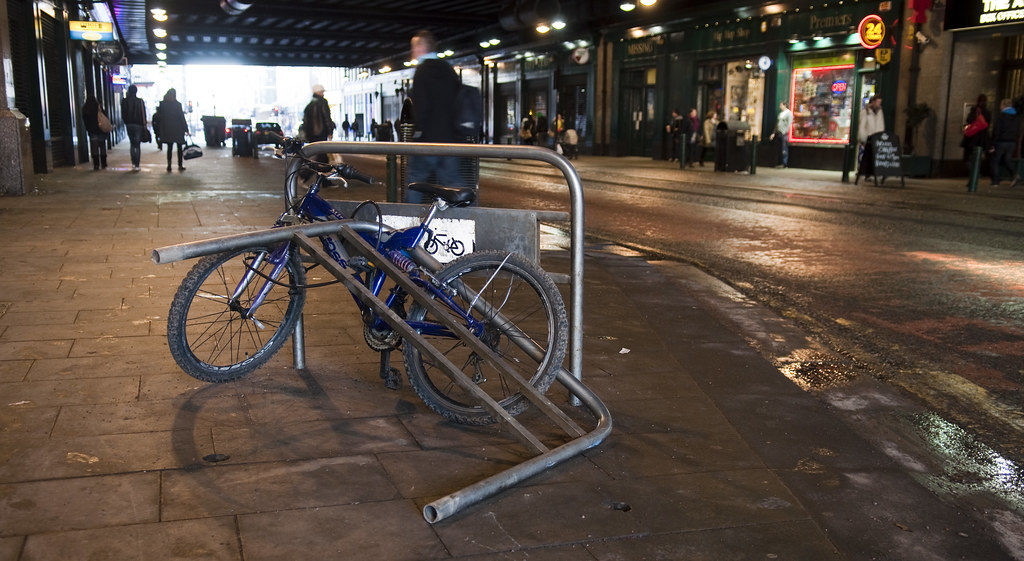
The cycle parking at Central Station should give you an idea of current political will. Indeed, political will seemed to be in short supply in general:
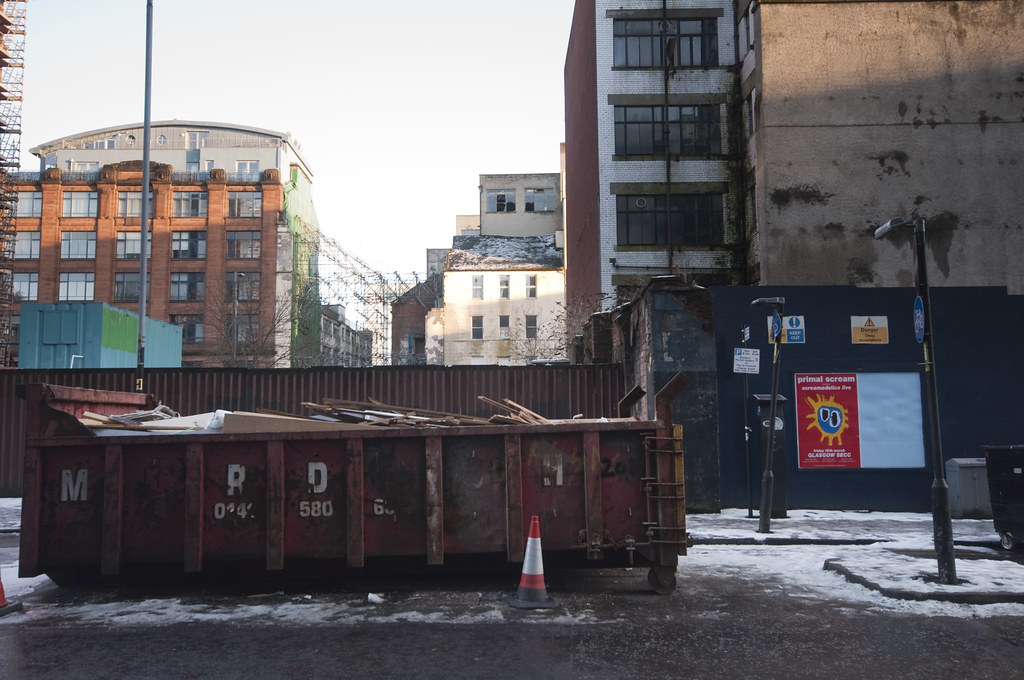
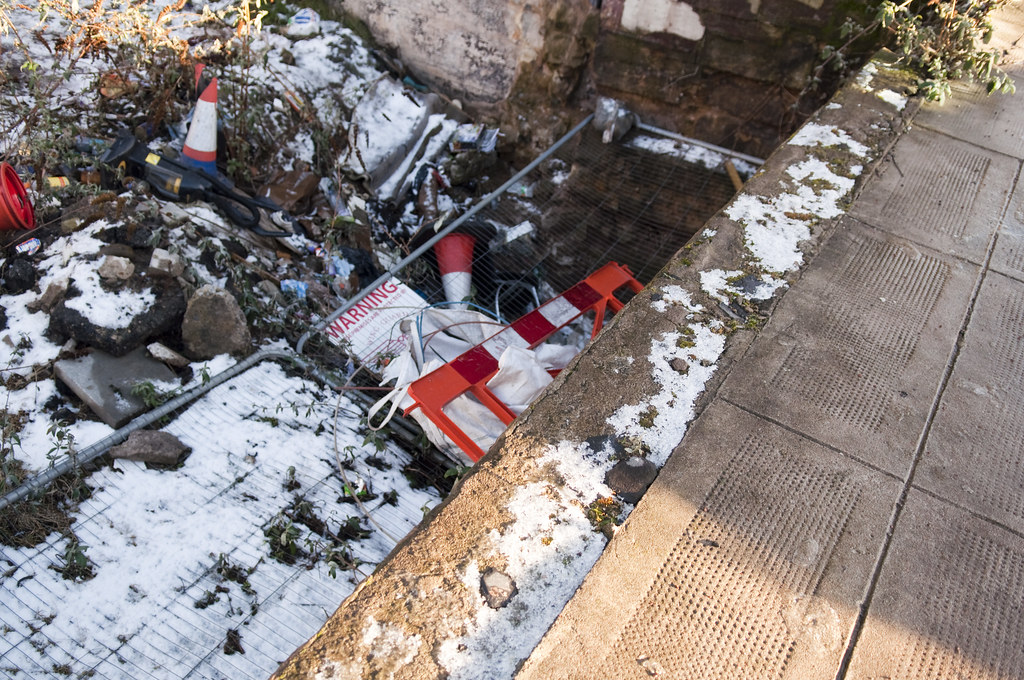
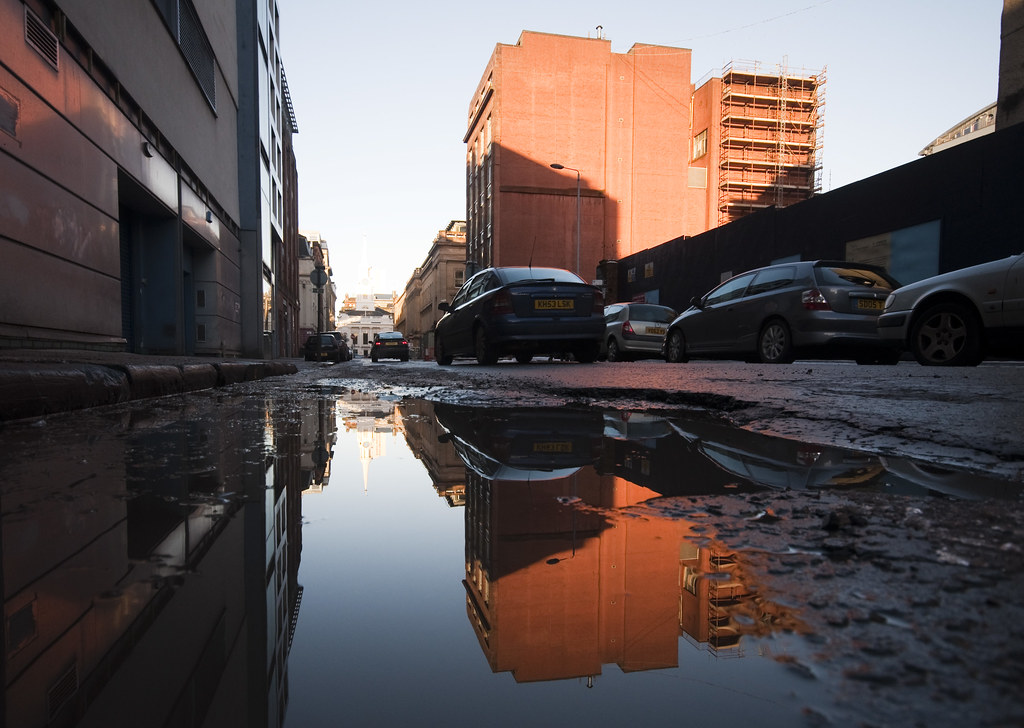


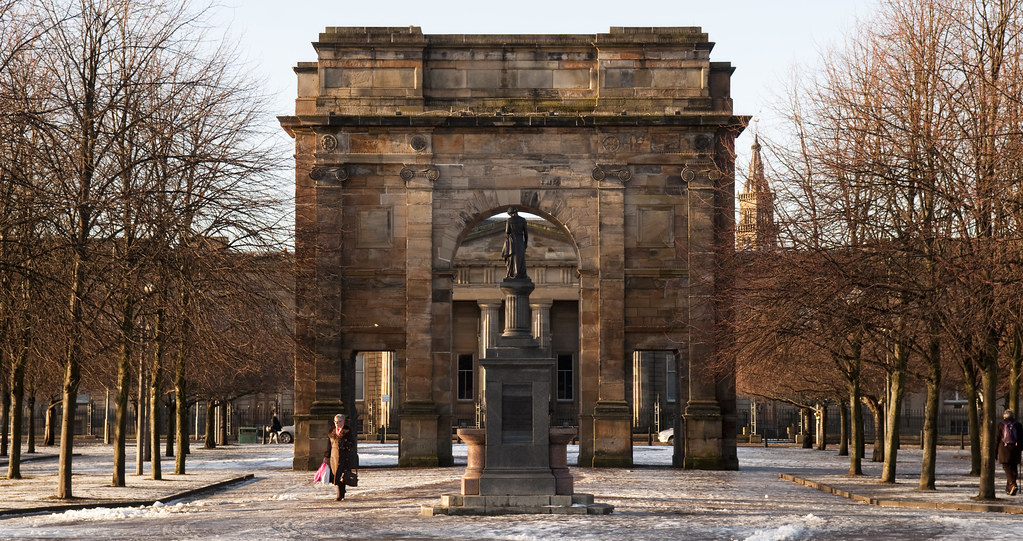
It looked like the council just weren’t able to keep up with all the repairs, maintenance, and enforcement, let alone worry about their street layouts.
But it wasn’t all bad. A little bit of road space has been taken away from the Motorist for what I assume is some sort of fancy bus lane?
And they were building some new shared space, where, freed from all that clutter, all road users could naturally behave themselves and be courteous without the need for the authorities to get involved with “traffic management” or “enforcement”:


And with motorists and pedestrians mixing more closely, pedestrians will be better able to appreciate the work of this vital commercial road user and his urgent message about the locally sourced (that means low food miles!) meat from James Campbell (butchers):

Glasgow has many nice features, of course. But its streets are generally not one of them, designed as they are without the slightest thought for anybody who isn’t behind a steering wheel. Not that it’s greatly worse than average for a British urban cycling and walking environment.
 At War With The Motorist
A lot of the bits of walkway and roadway twisting around the M8 aren’t half-demolished, they’re half finished- they were never properly connected up.
Of course, had the walkways been connected, then doubtless the other parts of the motorway would have been built too- whilst they’ve finally built the southern section of the inner ring, the eastern section will thankfully never be completed.
Of course, there’s the irony that for such a hostile city to cyclists (and, away from the precincts of Buchanan Street and Sauchiehall Street, hostile to pedestrians) driving there is a horrible experience. The M8 through the centre is best tackled with a native navigator/spotter, as lanes come in and leave on both sides with tightly curved, narrow, short on and off ramps, and no single lane continues all the way through. The lanes of the “Clydeside Expressway” are narrow, making for an interesting experience passing a bus. And those one-way systems…
Then there’s the rail network.
This manages to be extensive yet strangely sparse. The Subway only serves the west of the city centre, and has poor interchange with the main stations of Queen Street and Central. The main stations were built before through trains were considered. Many mainline stations on the suburban network are oddly out of the way, part hidden or just in places that are of little use to many- because of the awful cycle and foot links.
All this in a sprawling city with large areas of deprivation.
Like others who have moved from Glasgow to London I’ve made the counterintuitive discovery that cycling in the larger city is safer, and generally better, than in the smaller one.
Cycling in London certainly isn’t akin to some Nordic ideal, but the ever-increasing driver awareness of cyclists puts Glasgow in the shade, where cyclists are seen as an irritating anomaly rather than part of a nascent herd.
I love the photo of the tourist map (looks like the run up to the Kingston Bridge I think).
Like every great British industrial city rich in Victoria architecture Glasgow lost many buildings in the 1960s, but it probably suffered even more than it cousins due to the M8. The area around Charing Cross/St George’s Cross was especially fucked up by the motorway, as you can see if you compare this photo of the Grand Hotel (in Charing Cross), taken in 1897 (just north of the point where you shot the short film of the traffic), to the scene today. The fountain on the left survives (albeit lopsidedly), as does the curved, turreted building in the right background; but where the hotel stood all that’s left is the chasm of the M8.
Its amazing how in the ’60s, there was no foresight to what was going to be the outcome of these decisions. Belfast is a good example that escaped complete destruction from a series of urban motorways, check out the link below. http://www.wesleyjohnston.com/roads/belfasturbanmotorway.html
What’s worst is the mock up impression of a motorway alongside the Lagan:

Getting around the west end of Glasgow is pretty easy by bike and there are cycle routes into the city centre along the clyde.. crossing east to west is also fairly easy by bike, although you do have to bump up and along the pavements for some parts especially at the Royal Infirmary.. going from west to south or into the central station can be a bit of a nightmare by bike.. you can go at a leisurely pace and detour along the scenic route along the clyde of course but it isn’t really practical when you want to get from A to B quick style. You are taking your life in your own hands going along down Union street and over the jamaica bridge.. That isn’t really correct you are putting your life into other peoples hands to be honest.. Especially going past Egligton Toll where there the road becomes a left lane very quickly and cars just overtake you and cut you off regardless of the fact that you can’t move into the other lane because other cars are zooming straight past on the right hand side.. Glasgow is a great place for Sunday cycling and slowing down through parks and along canal paths but as a serious form of safe swift transport it is pretty patchy. Pot holes are lethal and car doors are also pretty frequently swung open .. I have been knocked off three times in the last 7 years and chased by young lads full of liquid refreshment twice .. I consider myself to be lucky that I have not had a serious accident.. actually incident would be the more appropriate term to use here.. The last incident left me with a broken left arm and right hand.. I couldn’t cook properly for four weeks and spent a fortune on take ways and ready meals.. I have lost a lot of confidence on the bike because I fear that I have used up my quota of luck and the next incident will be the the big one for me… People may say that is negative thinking but I am going on my own experience.. I have also seen two cyclists lying on the road as road in the last three years and I am not sure what the outcome was for them but it didn’t look too good for both of them.. Each time the car drivers involved looked really shaken and concerned for the cyclist they had hit but that seems to be how far it has to go for some car drivers to take on board the seriousness of the fact that they are dealing with peoples lives on the road.. I must add that a lot of car drivers are very aware and do give cyclists respect on the road.. But the most ideal form of transportation would be for the infrastructure to be in place for cars and bikes to be separated from each other as much as possible, that way we can all be safe and get about our business in peace..